What are the best eco-friendly options when customizing sticky notes

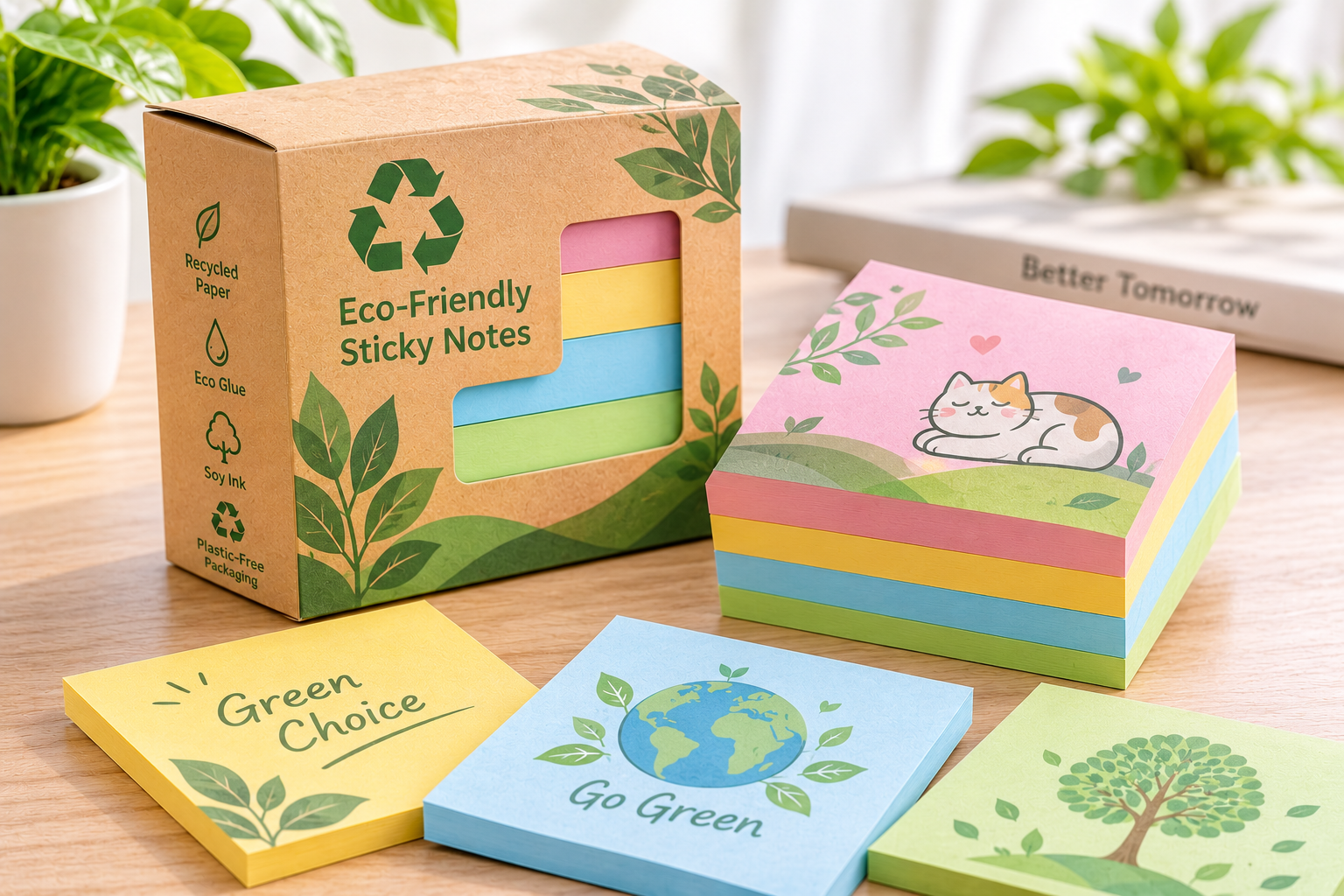
With the widespread promotion of environmental awareness, people have become increasingly conscious of the importance of sustainability. A growing number of brands, wholesalers, and buyers are now focusing on eco-friendly office supplies. As a common stationery item used in daily work, study, and personal life, sticky notes are also increasingly being produced using environmentally friendly materials.
The shift toward eco-friendly sticky notes represents a "green upgrade" that encompasses materials, manufacturing processes, certifications, and usage methods. This transition not only reduces resource consumption but also fosters a healthier and more sustainable approach to work, study, and creative activities.
Eco-friendly choices naturally begin with the selection of the materials themselves.
1. Paper
Paper is the primary component of sticky notes and the first factor to consider when opting for an eco-friendly solution. For custom eco-friendly sticky notes, the following types of paper are worth considering:
1.1 Recycled Paper
Recycled paper is made by processing recovered paper fibers and is a common material choice for eco-friendly sticky notes.
Characteristics of recycled paper include:
* It utilizes recovered paper fibers, reducing reliance on virgin pulp.
* The paper may feature a natural off-white, light gray, or other earthy tone.
* Thickness, surface texture, and writing experience can vary between different types of recycled paper.
* Print results are influenced by the paper’s color, smoothness, and ink-absorbency.
1.2 FSC-Certified Paper
FSC certification focuses on the responsible management of forest resources and the requirements of the associated supply chain. For brands that prioritize the origin of their paper and transparency in procurement, FSC-certified paper is another eco-friendly material option.
It is important to distinguish that FSC-certified paper is not the same as recycled paper. While FSC certification centers on forest resources and supply chain management, recycled paper emphasizes the use of recovered fibers; they represent different material attributes.
1.3 Virgin Paper (with traceable sourcing)
This type of paper may not necessarily contain recovered fibers, but its eco-friendly credentials can be evaluated based on its source and supply chain.
2. Adhesive
When selecting eco-friendly sticky notes, one must look beyond the paper and also consider the composition and performance of the adhesive.
Choosing an eco-friendly adhesive requires balancing material properties with practical, real-world performance.
2.1 Water-Based Adhesives
Water-based adhesives are a notable eco-friendly option. Compared to some traditional solvent-based adhesives, water-based systems reduce reliance on organic solvents.
2.2 Solvent-Free Adhesives
Solvent-free adhesives represent another eco-friendly category for procurement. When selecting these, it is advisable to confirm the specific adhesive system, material documentation, and applicable usage conditions with the supplier. One cannot judge the overall environmental friendliness of a product solely based on the term "solvent-free." A comprehensive assessment must also consider the adhesive's composition, the production process, and its performance in actual use.
2.3 Eco-friendly adhesives require practical testing
Choosing an eco-friendly adhesive does not mean compromising on tackiness. A balance must be struck between material selection and functional performance; for sticky notes, the adhesive not only influences the product's environmental impact but also directly determines the user experience.
3. Printing
Beyond paper and adhesive, the printing process is another critical aspect in the production of eco-friendly sticky notes. For sticky notes that feature brand logos, patterns, or color designs, purchasers may consider the following eco-friendly printing options:
3.1 Water-based inks
Water-based inks, which use water as a primary dispersion medium, are a common choice for eco-friendly printing. When using these inks, it is necessary to evaluate factors such as the paper's absorbency and the specific printing process to ensure clear patterns, stable colors, and adherence to the product's aesthetic requirements.
3.2 Soy-based inks
Soy-based inks are formulated using soybean oil or other plant-derived ingredients. Some brands and printing supply chains offer these as an alternative to traditional mineral oil-based inks. It is important to verify the specific formulation and intended application of the ink; the mere label "soy-based ink" does not automatically render the entire product fully eco-friendly.
3.3 Minimizing unnecessary ink usage
In addition to selecting the right type of ink, thoughtful print design—ensuring that text, patterns, and logos remain clear and attractive while avoiding excessive full-page coverage, an unnecessary number of colors, or redundant graphic elements—can help reduce the consumption of materials.
4. Packaging
Some clients may opt for eco-friendly paper but still rely heavily on plastic materials for packaging. Therefore, it is important to extend the eco-friendly philosophy to the product's packaging as well.
4.1 Recycled paper packaging
Recycled paper packaging is made from recovered paper fibers, making it an ideal solution for brands looking to reduce their reliance on virgin paper materials.
4.2 Kraft paper packaging
Kraft paper offers a natural, minimalist aesthetic, making it well-suited for eco-conscious stationery products. It can be used for outer packaging, paper sleeves, and various other packaging components. 4.3 Replacing Certain Plastic Packaging
Depending on the product’s protection requirements, paper-based packaging can be used as an alternative to some plastic packaging.
4.4 Reducing Excessive Packaging
An appropriate packaging solution helps businesses strike a balance between product protection and environmental requirements.
Beyond simply changing packaging materials, environmental goals can also be advanced by optimizing packaging design. First, reduce unnecessary packaging layers; while ensuring the product remains adequately protected, simplify multi-layered structures to the essential minimum and scale back purely decorative elements. Second, optimize packaging dimensions by following the "just-right" principle—ensuring the size is neither too large nor too small—to avoid material waste. Finally, avoid the use of excessive, non-functional decorative materials—such as overly elaborate gift boxes, foil stamping, or plastic laminates—which not only increase costs but can also hinder recyclability.
Customizing Eco-Friendly Sticky Notes: How to Best Combine Sustainable Materials
When selecting eco-friendly sticky notes, it is not necessary for every component to utilize the exact same type of sustainable material. Buyers can combine various materials based on product positioning, budget, and the target market.
Reference Options for Material Combinations
|
Plan |
Paper Selection |
Choosing an Adhesive |
Print Options |
Packaging Options |
|---|---|---|---|---|
|
Basic Environmental Protection |
Recycled paper |
Evaluated eco-friendly glue |
Water-based ink |
Recycled paper packaging |
|
Brand Environmental Responsibility |
FSC-certified paper |
Compliant eco-friendly glue |
Water-based or soy-based inks |
Corresponding certified paper packaging |
|
Natural Style |
Natural-colored recycled paper |
Tested eco-friendly glue |
Simple Printing |
Kraft paper packaging |
|
Lightweight packaging |
Select eco-friendly paper based on your requirements |
Select based on performance requirements |
Reduce unnecessary printing |
Simplify paper-based packaging |
The above is for reference only; different combinations offer distinct characteristics. The final approach should be determined based on actual circumstances and a comprehensive consideration of all relevant factors.
Comparison of Eco-Friendly Sticky Note Suppliers
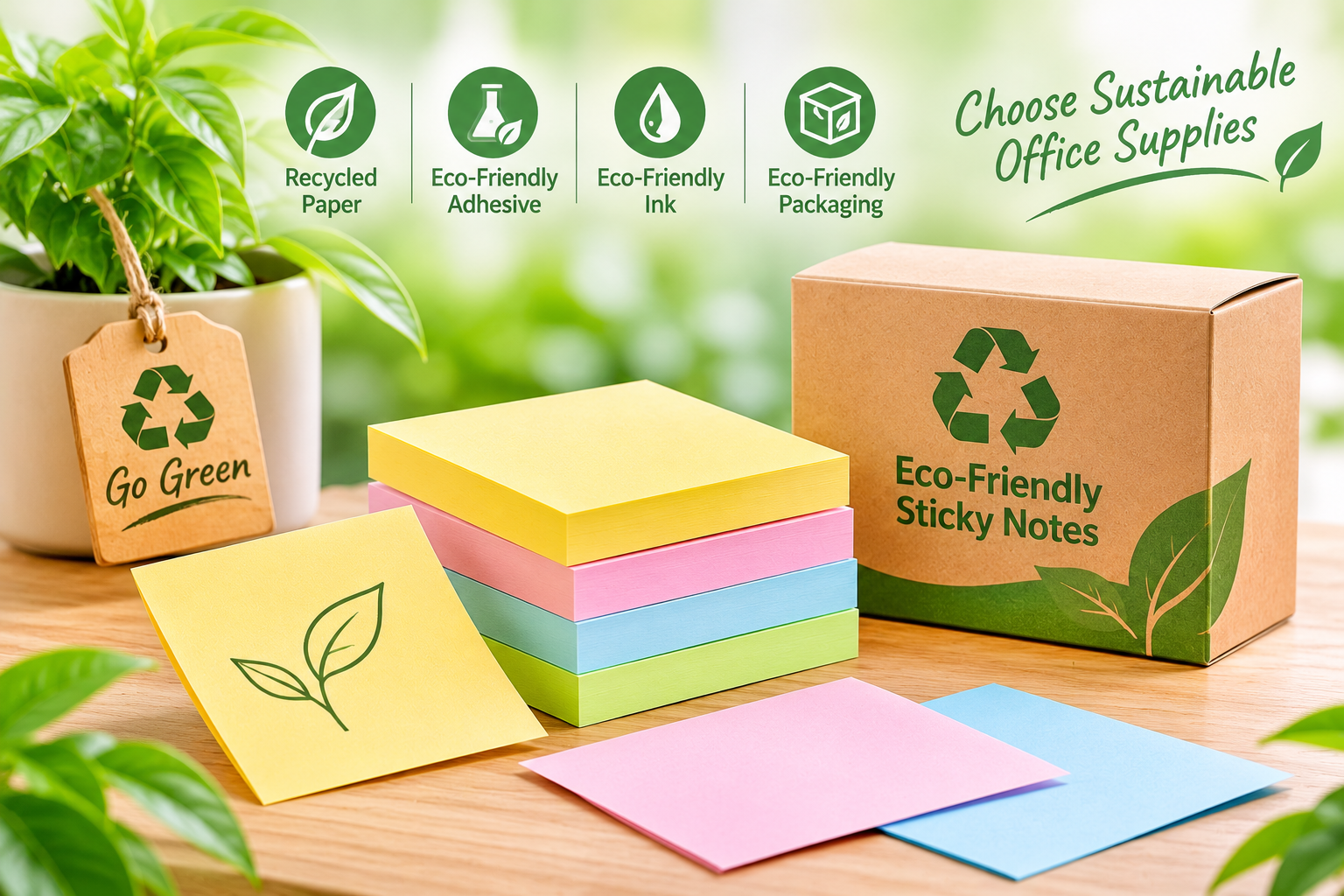
For buyers sourcing eco-friendly sticky notes, the primary consideration—beyond whether the materials meet specific environmental requirements—is the variety of eco-friendly options offered by different suppliers. Some suppliers focus on recycled paper, while others specialize in eco-friendly adhesives or certified paper products. To effectively meet diverse client needs, it is crucial to develop a collaborative approach to eco-friendly materials that spans the entire process, from initial communication to final design.
Comparison Table for Custom Eco-Friendly Sticky Note Suppliers
|
Comparison Item |
Yadi Stationery |
UPM |
Club of Notes |
NOTEDECO |
|---|---|---|---|---|
|
Eco-friendly paper |
FSC-certified paper, recycled paper, and other eco-friendly papers |
Recycled paper, FSC-certified products |
Recycled paper, optionally certified paper |
Recycled paper |
|
Eco-friendly glue |
Water-based, solvent-free adhesive |
Water-based, solvent-free adhesive |
Water-based glue |
Specific details need to be confirmed |
|
Eco-friendly Printing |
Water-based inks, soy-based inks |
The specific ink solution needs to be confirmed |
The specific ink solution needs to be confirmed |
For items related to printing or inks, confirmation is required |
|
Eco-friendly packaging |
Packaging such as recycled paper and kraft paper |
Recycled paper packaging |
Specific details need to be confirmed |
Specific details need to be confirmed |
|
Eco-friendly material combinations |
Facilitate comprehensive communication regarding materials for paper, adhesives, printing, and packaging |
There are related product series |
Some material combinations are available |
Product information prevails |
Why Choose Yadi Stationery https://ecbuys.com/about-us/
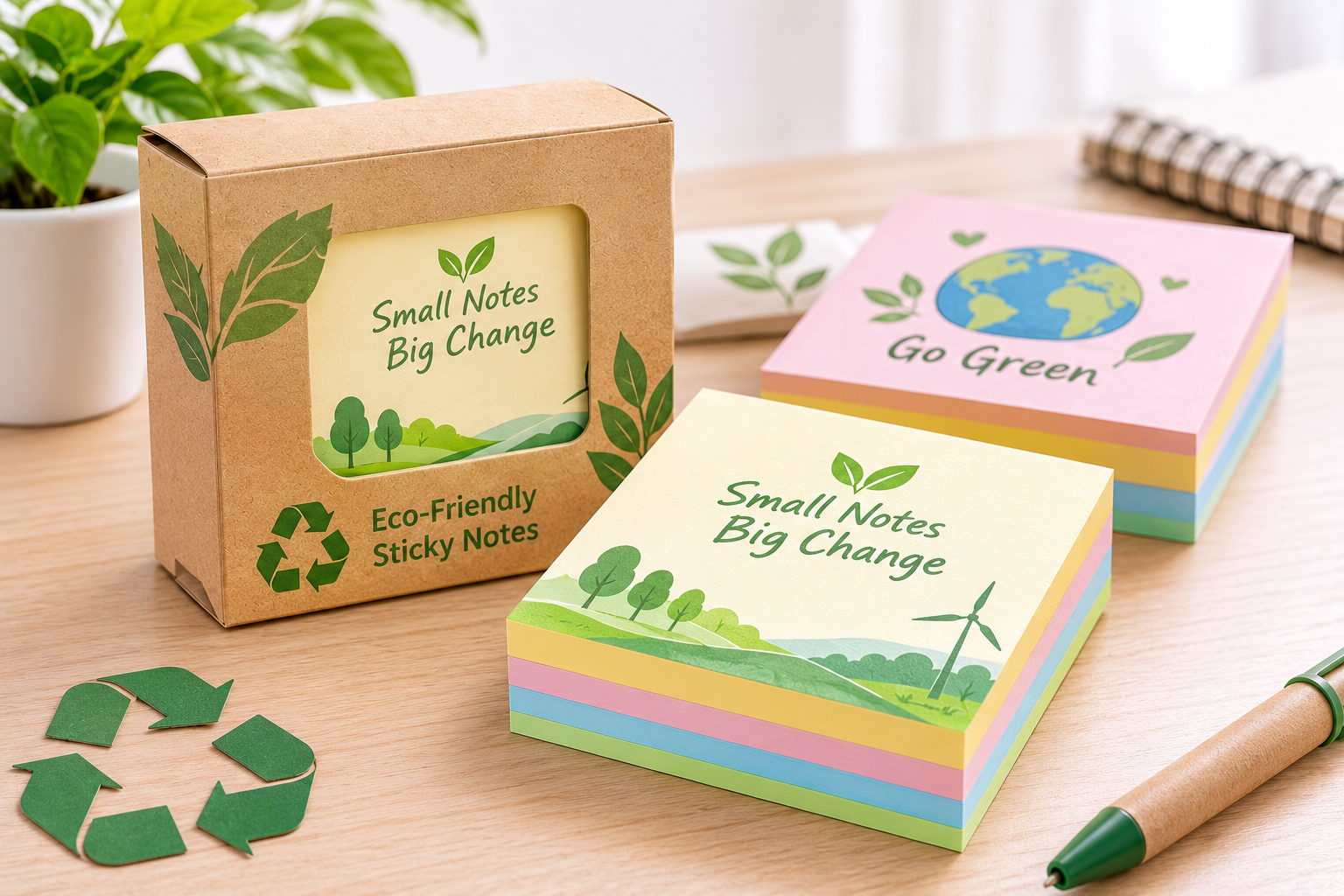
With over 17 years of expertise in manufacturing sticky notes, Yadi Stationery offers comprehensive eco-friendly solutions—from raw material sourcing to every stage of the production process. We assist clients in selecting the ideal sustainable approach tailored to their specific product positioning and procurement requirements.
* Eco-friendly Paper Selection
Paper is the fundamental component of any sticky note. We prioritize the selection of environmentally responsible paper, evaluating recycled options and other materials that meet specific sustainability standards.
Since different papers vary in color, thickness, surface texture, writing experience, and print quality, we ensure that the chosen material aligns perfectly with the intended use of the final product.
* Eco-friendly Adhesives
The user experience of a sticky note is closely tied to its adhesive. We carefully select eco-friendly adhesives and precisely control their application, ensuring that while the materials remain environmentally conscious, the product also delivers excellent adhesion, a smooth removal experience, and leaves no residue behind.
* Eco-friendly Printing
For sticky notes featuring designs, text, or brand logos, the printing materials and processes are equally critical.
* Eco-friendly Packaging
Product packaging is a vital element of a sustainable solution. We offer various options—such as recycled paper or kraft paper packaging—to help clients minimize unnecessary packaging materials based on their specific product and procurement needs.
* Holistic Material Integration and Quality Control
Creating eco-friendly sticky notes is not just about choosing a single material; it is about the seamless integration of paper, adhesive, ink, and packaging.
Throughout the production process, we focus on material selection and rigorous quality control—paying close attention to adhesive application, print quality, and the actual end-user experience—to help our clients strike the perfect balance between environmental responsibility and product performance.
When sourcing custom eco-friendly sticky notes, buyers must consider factors that extend well beyond the paper itself—including the adhesives, printing inks, and product packaging. Options for creating eco-friendly sticky notes include using recycled paper, FSC-certified paper, water-based adhesives, eco-friendly printing inks, and paper-based packaging. Since each material has its own unique characteristics, the final solution should be determined based on factors such as product positioning, the target market, and budget.
Yadi Stationery places a strong emphasis on eco-friendly practices across the entire production process—from the paper, adhesives, and printing inks to the final packaging—while also ensuring high standards for adhesive application, print quality, and the overall excellence of the finished product. If you are looking for a manufacturer for custom eco-friendly sticky notes, please contact Yadi Stationery https://ecbuys.com/contact-us/to explore the eco-friendly materials and production solutions best suited to your specific needs.