When was sticky notes invented


Today, sticky notes—also known as repositionable notes, self-adhesive notes, or memo pads—are a common office supply. While they traditionally come in square or rectangular shapes, the evolution of the product has led to a wide variety of unique designs, such as stars, hearts, leaves, and little houses. Whether for organizing tasks or marking important information, these small notes offer great convenience.
After using sticky notes for so long, have you ever wondered how they came to be or when they were invented?
The invention of the sticky note was not the work of a single person; the story began with the discovery of a unique adhesive, which was subsequently developed into the product we know today.
The story of the invention of the sticky note dates back to 1968...
Two key figures in the history of the sticky note's invention are Spencer Silver and Art Fry. Both worked for the American company 3M, though their contributions differed:
1. Spencer Silver — Inventor of the reusable adhesive
English name: Spencer Ferguson Silver

Role: American chemist and 3M scientist
Key contribution: In 1968, he discovered a unique low-tack, pressure-sensitive adhesive. This adhesive could stick to surfaces yet be easily removed, providing the crucial technology for the eventual creation of the sticky note.
Lifespan: 1941–2021
His story:
Silver was originally researching new types of adhesives, hoping to develop a stronger glue. However, the adhesive he discovered was unlike traditional glues: it consisted of tiny spherical structures that could grip objects without forming a particularly strong, permanent bond.
Initially, no immediate, suitable application was found for this discovery. Nevertheless, he continued to share the technology with his colleagues. It was only later, when another 3M scientist—Art Fry—drew inspiration from it, that this unique adhesive truly made its way into everyday office life.
2. Art Fry – The man who turned the Post-it Note into a practical product
English Name: Arthur L. Fry

Role: American inventor, scientist, and 3M product developer
Key Contribution: He applied the special adhesive invented by Spencer Silver to paper, creating a bookmark that could be repeatedly stuck on and peeled off, and subsequently developed this concept into the Post-it Note product.
Year of Birth: 1931
What inspired him to invent the Post-it Note?
In 1974, while practicing with his church choir, Fry frequently encountered the problem of paper bookmarks falling out of his hymnal. He wanted to find a bookmark that would stay in place on the page but wouldn't damage the paper when removed.
He recalled the special adhesive Spencer Silver had previously introduced and began experimenting by applying it to paper. He later discovered that this paper could serve not only as a bookmark but also for writing notes, marking documents, and conveying messages. This marked the beginning of the product concept that would become the Post-it Note.
The story begins...
In 1968, 3M assigned chemist Spencer Silver a task: to create a strong adhesive that could be repeatedly applied to surfaces and removed without leaving a trace. During his research, however, he discovered an adhesive quite different from what was originally expected. Instead of the traditional type of glue that bonds increasingly tightly over time, this substance featured a unique microsphere structure that provided adhesion while allowing for easy separation.
This discovery did not immediately result in a finished product; Spencer Silver spent five full years introducing and demonstrating it to his colleagues.
Then, in 1974, Art Fry—who used slips of paper to mark pages in his hymnal during church choir practice—found himself constantly flustered as the markers fell out whenever he turned a page. He then recalled the adhesive Spencer Silver had previously described.
The very next day, he created a prototype: a small slip of paper coated with adhesive. When stuck onto a sheet of music, it stayed put; it could be peeled off, moved to another page, and re-stuck just as effectively. Through continued experimentation, they discovered that these slips were versatile—useful not only as bookmarks but also for leaving messages, marking documents, and jotting down quick notes. Initially, only a small group within the company used them, but word spread, and soon employees across the entire organization were asking for them. Thus, it gradually evolved into a new type of office product.
In 1977, 3M launched a small-scale commercial release of its first adhesive-backed paper product—named "Press’n Peel"—in select U.S. cities; it was an instant hit. Following product refinements and marketing efforts, the company secured patents for the adhesive technology and trademark rights for the "Post-it" brand. The product was subsequently launched nationwide in the U.S. on April 6, 1980, and Post-it Notes gradually became a household name in office supplies.
The journey from a specific adhesive technology to a brand-new stationery product demonstrates that innovation does not always stem from complex engineering; often, it arises from everyday observations, a simple idea, and the subsequent process of refinement.
Why is the adhesive so important for sticky notes?
For many users, the most obvious advantage of sticky notes is the ease of writing on them and sticking them wherever needed. However, from a manufacturer's perspective, the adhesive is actually a crucial factor determining the user experience.
If the adhesive lacks sufficient tack, the notes may fail to stay securely in place on documents, books, or desktops; conversely, if the adhesion is too strong, removing them may not be smooth, potentially leaving behind sticky residue. Therefore, sticky notes require a precise balance between adhesion and removability.
Furthermore, the uniformity of the adhesive application, its drying characteristics, and its compatibility with the paper all influence the performance of the finished product. Uneven application or inconsistent production controls can lead to variations in stickiness within the same batch.
This is why the manufacturing of sticky notes cannot focus solely on the paper itself. Paper quality, adhesive selection, the application process, and subsequent processing steps must all work in harmony to ensure the final product meets practical usage requirements.
Consequently, clearly defining the product's intended use and verifying specific requirements through samples prior to production is a vital step.
What production steps are involved in transforming a sheet of paper into a pad of sticky notes?
Although the structure of a sticky note appears simple, the journey from raw material to finished product involves multiple, indispensable production stages that must work in concert.
The process begins with paper selection. Factors such as paper color, thickness, surface texture, and writing performance directly influence the product's appearance and user experience.
Next comes the adhesive application. The glue must be applied according to specifications, with precise control over placement and uniformity. Following application, the paper undergoes drying and processing to ensure smooth subsequent steps—namely cutting, stacking, and packaging.
Then come the slitting, cutting, and collation stages. For standard sticky notes, the focus is on controlling finished dimensions and edge neatness; for colored cube sticky notes, attention must also be paid to the arrangement of colored sheets and the overall thickness of the stack. Issues such as dimensional deviations or misaligned paper can compromise the product's appearance.
Finally, there are quality inspection and packaging. Finished products undergo checks not only for appearance but also for adherence to specifications regarding adhesiveness, ease of removal, dimensions, and packaging quality. For custom orders, it is also necessary to verify that printed patterns, logos, and packaging designs align with the approved samples.
While these steps may seem like routine production tasks, they are the factors that determine the product's consistent quality.
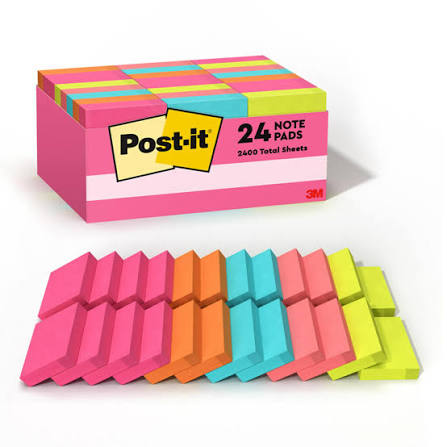
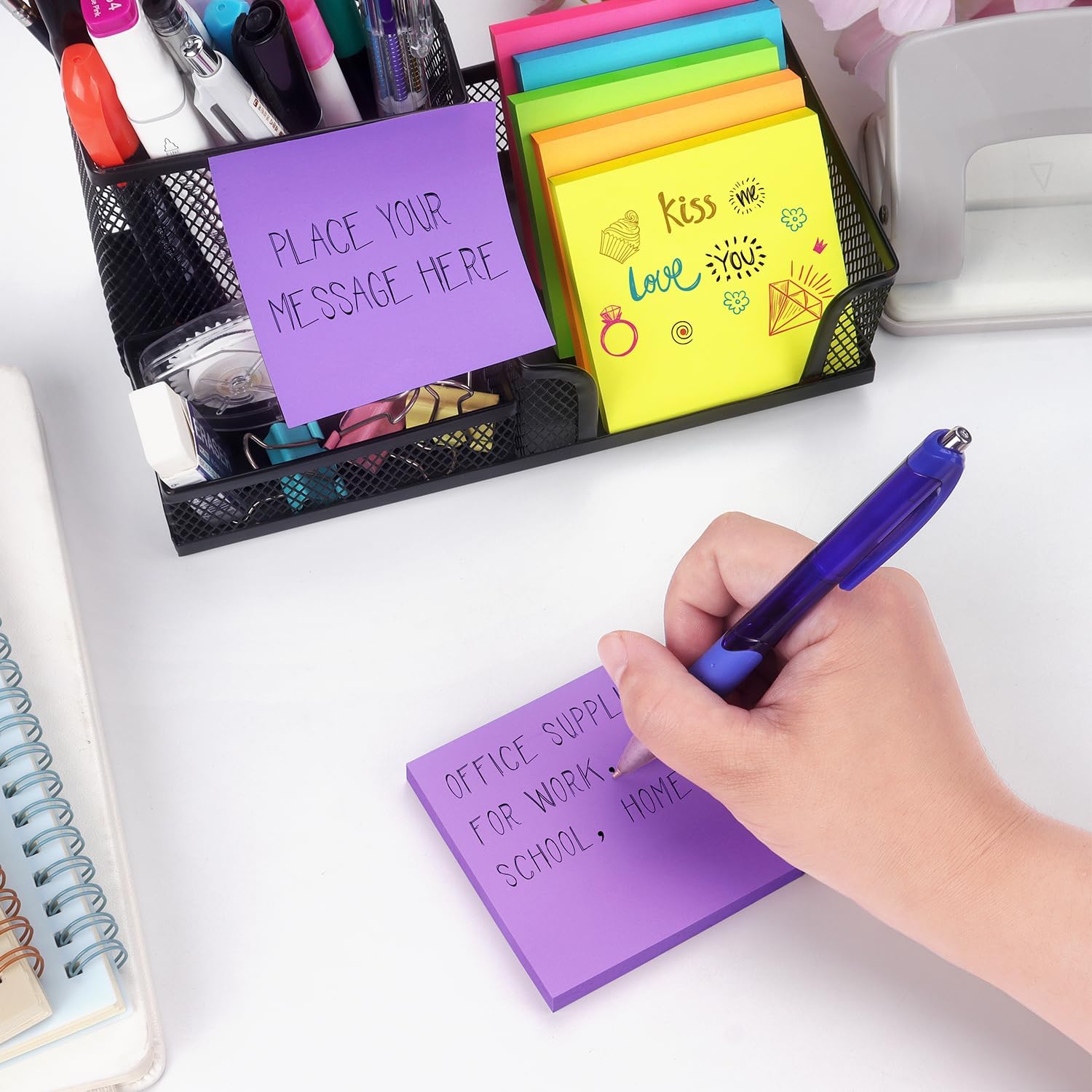
Modern sticky notes have evolved far beyond the classic yellow variety.
For many, the introduction to sticky notes began with the iconic yellow version. However, driven by changing office needs and advancements in stationery design, a wide array of styles is now available.
In a typical office setting, standard sticky notes serve to jot down to-do lists and quick reminders; colorful square notes are ideal for organizing workflows, categorizing tasks, and brainstorming; and index tabs help users quickly locate key information in documents or books.
For corporate and brand clients, sticky notes can also serve as customized office stationery. By tailoring aspects such as size, color, paper quality, printed content, and packaging, these products can be aligned with specific corporate needs while helping to build a distinct brand image.
Thus, the evolution of sticky notes reflects not only shifts in product design but also the office stationery market's enduring demand for practicality, personalization, and customization capabilities.
Yadi Stationery: Specializing in Sticky Note Production and Customization
At Yadi Stationery https://ecbuys.com/about-us/, with our long-standing focus on manufacturing sticky notes, we fully recognize that quality extends far beyond mere appearance. Every stage of production—from paper selection, adhesive application, and cutting to final inspection and packaging—influences the end-user experience.
The choice and application of adhesive are critical factors in determining quality. Sticky notes must adhere securely yet peel off easily, while minimizing issues such as curling, poor adhesion, or adhesive residue caused by unsuitable glue. Consequently, we pay close attention to adhesive placement, application uniformity, and dosage control, making precise adjustments throughout the production process.
Following adhesive application, we carefully manage the drying and subsequent processing stages to ensure that process variables do not compromise the adhesive's performance. For sticky notes varying in size, paper type, and intended use, we validate samples against product specifications to ensure consistency between the samples and mass-produced goods.
Only by prioritizing these production details can we effectively meet our customers' demands for high-quality sticky notes and reliable, long-term supply stability.
Yadi Stationery https://ecbuys.com/contact-us/ offers custom manufacturing for sticky notes and related paper stationery. We collaborate with traders, office supply purchasers, stationery brands, and other B2B clients to provide OEM/ODM services, tailoring product dimensions, colors, page counts, print designs, and packaging methods to specific customer requirements.