How were Post-it Notes invented


Sticky notes—those handy slips of paper you can quickly jot on, tear off, and stick anywhere—are a common office staple in our daily lives and serve as invaluable reminders for students and professionals alike. Whether you are noting down tasks at the office, marking key points in a book, or organizing ideas during a meeting, a small sticky note can make a big difference.
But have you ever wondered how sticky notes came to be? Did they always look the way they do today? Their creation is the result of a unique adhesive discovered by accident, a minor practical issue, and a process of continuous design improvement.
To understand how the Post-it Note was invented, one must first look at the nature of glue.
Conventionally, the primary function of glue is to bond two objects firmly together. But what if an adhesive could hold objects in place while allowing them to be easily removed—and even re-adhered under the right conditions? What else could it be used for?
This question lies at the heart of the story behind the invention of the Post-it Note.
In 1966, after earning his doctorate, Spencer F. Silver joined 3M. His research team was tasked with developing a stronger adhesive. However, an adhesive's performance depends not only on the strength of the bond but also on the material's composition and structure.
One day in 1968, while conducting experiments, Silver accidentally discovered a pressure-sensitive adhesive with unique properties. Unlike typical strong glues, this adhesive was relatively weak in terms of bond strength yet highly effective at clinging to surfaces; it could be removed without damaging the surface and was reusable.
Discovering a new material, however, did not automatically mean it could be turned into a commercial product. At the time, 3M management showed little interest in the new adhesive because it failed to meet the research team's original objective. Even Silver himself was unsure how to transform the discovery into a viable product.
Later, another 3M engineer, Art Fry, found a practical application for this unique adhesive.
Art Fry frequently participated in church choir activities, where he needed to mark specific songs in his hymnal. While ordinary paper bookmarks were simple, they often slipped out of the pages and failed to stay securely in place.
He began to wonder: wouldn't it be far more convenient to have a bookmark that could be affixed to the page, removed when needed, and used without damaging the book? At that moment, he recalled a special adhesive invented by Spencer F. Silver.
The next day, he obtained some of the adhesive from Silver, created a prototype of a self-adhesive bookmark, and tested it during his next rehearsal. He found the bookmark highly effective, though it did leave a slight residue upon removal.
To ensure the adhesive adhered better to the bookmark itself, Dr. Art Fry made further refinements.
He then distributed samples of the new bookmark to colleagues for testing and continued to adjust the product based on their feedback. Through repeated experimentation and improvement, the concept evolved into a more practical product form, and the utility of this unique adhesive became apparent to a wider audience. Following further development and marketing, this small "sticky note" became an essential item in the daily work and lives of many people within just a few years.
What began as a simple need revealed a new way of using paper: beyond merely serving as a writing surface, paper could also function as a flexible, adjustable tool for note-taking and marking.

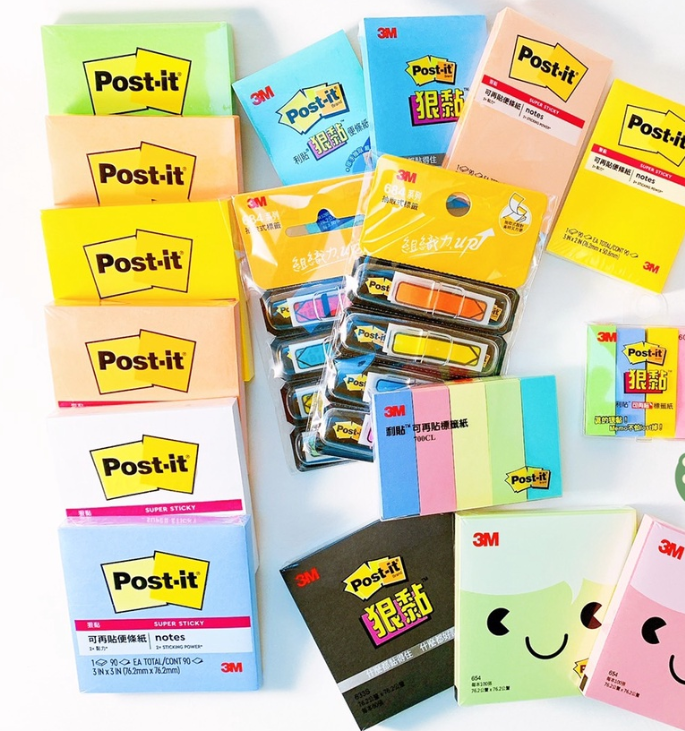
Sticky notes are the result of combining adhesive and paper.
Developing an idea into a finished product involves solving a key challenge: how to best bond the specialized adhesive with the paper.
If the adhesive lacks sufficient tack, the note won't stay securely in place; if it is too strong, it may leave behind a sticky residue upon removal. Consequently, the product must strike the right balance between adhesion and removability.
Furthermore, the paper itself plays a crucial role in the user experience. Factors such as paper thickness and surface characteristics affect how the note performs during writing, tearing, and application. The adhesive and the paper cannot be considered in isolation; they must work in tandem to function effectively.
A sticky note is more than just a standard sheet of paper with a strip of glue; it represents a harmonious integration of paper, adhesive, and practical utility. It transforms an ordinary piece of paper into a versatile tool—one that can record information, be temporarily affixed in a convenient spot, help organize thoughts, and be easily repositioned or replaced as tasks evolve.
The development of sticky notes involves various stages, including design, continuous refinement of manufacturing processes, and market testing. Beyond verifying the performance of the specialized adhesive, developers must also consider factors such as paper format, product specifications, and the feasibility of mass production.
To the consumer, a sticky note appears deceptively simple: a piece of paper that can be written on, adhered to a surface, and easily removed when needed. However, achieving a reliable combination of these functions requires far more than just a single creative idea.
Is the product easy to access? Does it stay securely in place after being applied? Is it convenient to remove? Does it meet user needs across various usage scenarios? These questions determine whether a sticky note can evolve from a mere concept into a truly practical office essential.
This demonstrates that a product's success rarely hinges solely on its initial invention. Ongoing design improvements, production optimization, and successful market application are all crucial to ensuring it becomes a genuine part of everyday life.

From Traditional Sticky Notes to Today’s Diverse Product Range
Sticky notes are no longer limited to the classic yellow squares of the past. To meet varying customer requirements and use cases, the market now offers products in a wide range of sizes, colors, shapes, page counts, and packaging formats.
Standard sticky notes serve for everyday note-taking, while colorful square notes are ideal for organizing tasks and categorizing information. Meanwhile, custom-printed notes—featuring corporate logos, brand colors, and unique designs—are perfect for office use and brand promotion.
Customer requirements vary widely. Some prioritize paper quality and the writing experience, while others focus on adhesive performance; still others place greater emphasis on visual design, print quality, packaging, and procurement costs.
Consequently, the development and customization of modern sticky notes must go beyond basic functionality to consider specific application scenarios, branding needs, and the reliability of bulk supply.
From the Invention of Sticky Notes to Modern Manufacturing Processes
A seemingly simple product often requires the seamless integration of materials, design, and manufacturing processes to meet customer needs. This is certainly true for sticky note manufacturers.
The choice of paper affects the writing experience, product thickness, and overall tactile quality; the selection and application of adhesive determine adhesion performance, ease of removal, and stability during use; precision cutting ensures clean edges; and printing and packaging influence the product's visual appeal and brand image.
In actual production, these elements must work in harmony. Even with a finalized design, inconsistencies in paper quality, adhesive application, or processing techniques can result in a final product that falls short of customer expectations.
At Yadi Stationery https://ecbuys.com/about-us/, we specialize in the manufacturing and customization of sticky notes and related paper-based stationery. We collaborate with clients to develop products tailored to their specific requirements, covering dimensions, paper colors, page counts, print designs, and packaging options.
For brands, stationery traders, and office supply purchasers seeking OEM/ODM services, it is crucial to look beyond appearance and price. Key considerations include sample approval, adhesion performance, and consistency between samples and mass-produced goods. These factors collectively determine the final product quality and the overall reliability of the long-term supply partnership.
The invention of the sticky note demonstrated how combining paper with a specialized adhesive could create a simple yet practical product. Today, the continuous refinement of materials and manufacturing processes remains the foundation for producing high-quality sticky notes.
If you are looking for a manufacturing partner for custom sticky notes or paper-based office stationery, please contact us at Yadi Stationery https://ecbuys.com/contact-us/ to discuss your product specifications, design requirements, and procurement plans.